

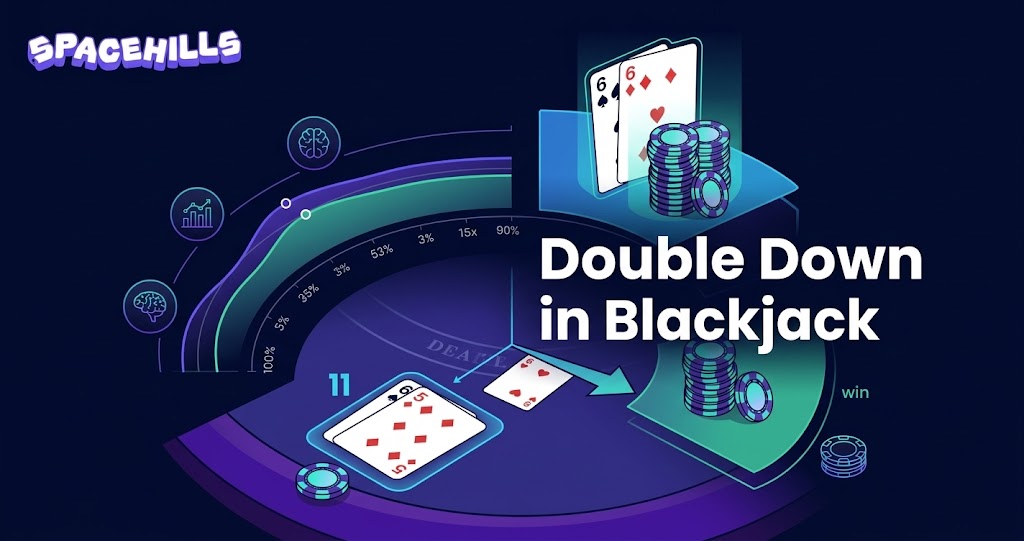
Knowing when to double down in blackjack can help you make better decisions when your first two cards create a favourable opportunity. However, increasing your bet at the wrong moment can make a losing hand twice as costly.
Before exploring blackjack at Space Hills casino, it helps to understand how doubling works and when it deserves consideration. This guide explains the rules, hard and soft hands, a quick-reference chart, and examples of winning and losing doubles.
What Does Double Down Mean in Blackjack?
Doubling down means increasing your original bet by an equal amount after receiving your first two cards. In exchange, you receive exactly one additional card and must stand, regardless of your final total.
For example, if you start with 10 units, doubling brings your total wager to 20 units.
The decision is about taking a calculated risk when your starting hand offers a favourable opportunity, rather than simply hoping for a lucky card.
Once you understand the move, you can explore the live games available at Spacehills, including blackjack and other traditional casino favourites.
Blackjack Double Down Rules
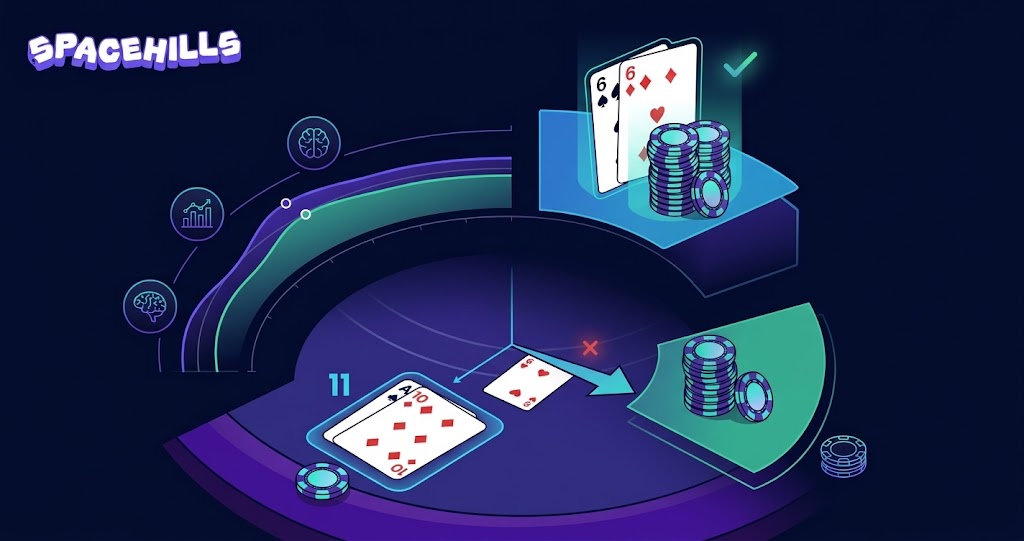
The standard double-down rule allows you to increase your wager immediately after receiving your first two cards, before taking a hit.
However, blackjack variations may have different restrictions. Some tables allow doubling on any initial two-card total, while others limit the option to specific totals, commonly 9, 10 or 11.
You should also check whether doubling is permitted after splitting a pair.
Spacehills lists several blackjack variations, so review the rules of your chosen game before playing.
If you’re exploring online promotions, remember to check the relevant terms separately. Bonus eligibility and wagering contributions can vary between casino games.
Double After Split (DAS)
Double After Split, or DAS, is a blackjack rule that allows you to double down on a new hand created by splitting a pair.
Suppose you receive two cards of equal value and decide to split them. Each card becomes the starting point of a separate hand, with another card dealt to each.
If one of those hands develops into a favourable total, DAS may allow you to increase your wager on that hand.
Without DAS, you cannot double after splitting.
This distinction matters because the option to double can affect whether splitting a particular pair is worthwhile. Always check the table rules before relying on this move.
When to Double Down in Blackjack
Your starting total and the dealer’s visible card are the two main factors to consider before doubling.
Blackjack hands fall into two categories: hard and soft. Understanding how each responds to an additional card helps you assess whether increasing your wager makes sense.
Doubling Down on Hard Hands
A hard hand contains no Ace, or an Ace that must count as 1 to prevent the total from exceeding 21.
For example, a 6 and a 5 make hard 11, while a 7 and a 3 make hard 10.
Hard totals of 9, 10 and 11 deserve particular attention because another card can produce a strong final hand.
Consider hard 11. Drawing a 10, Jack, Queen or King brings your total to 21. Since four card ranks have a value of 10, there are several ways to reach that result.
However, you should never look at your cards in isolation.
A dealer showing a 5 or 6 presents a different situation from one showing a 10-value card or Ace. The dealer’s upcard changes the calculation because it affects the possible outcomes of their hand.
Hard 9 also requires a different approach from hard 11. A single additional card may leave you with a relatively modest total, even when you avoid going over 21.
The key is to consider both hands before increasing your bet.
Doubling Down on Soft Hands
A soft hand contains an Ace counted as 11 without taking the total above 21.
For example:
- Ace and 2 make soft 13.
- Ace and 5 make soft 16.
- Ace and 7 make soft 18.
The advantage of a soft hand is the flexibility of the Ace.
Suppose you have an Ace and a 6, giving you soft 17. If you draw a 9, the Ace changes from 11 to 1, leaving you with 16 instead of 26.
This means an initial two-card soft hand cannot bust from receiving just one additional card.
That flexibility can make certain soft totals worth considering for a double, particularly when the dealer has a weaker upcard.
However, avoiding an immediate bust is not the same as securing a winning hand.
You might receive a low-value card and finish with a total that the dealer can beat. Always consider the possible final total before increasing your wager.
Quick-Reference Double Down Chart
Use this chart to identify the starting hands that deserve closer consideration.
It explains the relevant decisions rather than prescribing exact dealer-upcard thresholds for every blackjack variation. Spacehills does not publish a table-specific doubling strategy chart on the accessible pages reviewed, so check your chosen game’s rules before following a particular strategy.
| Your Hand Total | Dealer’s Upcard | Action |
| Hard 9 | Consider the dealer’s visible card, particularly weaker upcards. | Check whether doubling offers a better opportunity than taking a normal hit. |
| Hard 10 | Compare your total with the dealer’s card. | Consider doubling when the applicable strategy supports it. |
| Hard 11 | Pay particular attention to strong dealer upcards, including 10-value cards and Aces. | A potential doubling opportunity, subject to the table rules. |
| Soft 13 or 14 | Look for a favourable dealer upcard. | Consider whether the flexibility of your Ace makes doubling worthwhile. |
| Soft 15 or 16 | Assess the dealer’s position. | Compare doubling with taking a normal hit. |
| Soft 17 or 18 | Check the dealer’s card and the rules of the game. | Consider whether receiving only one additional card justifies increasing your bet. |
Remember that a hand qualifying for doubling under the rules does not automatically make doubling the correct strategic decision.
How to Double Down at the Table
At a physical blackjack table, doubling involves placing an additional wager and signalling your decision to the dealer.
The usual process is straightforward:
- Receive your first two cards and check the dealer’s visible card.
- Decide whether doubling is permitted and appropriate for your hand.
- Place an additional stack of chips equal to your original wager beside it, rather than on top.
- Signal your decision using the accepted hand gesture or a verbal request.
- Receive one additional card and wait for the dealer to finish the round.
At some tables, the additional card is placed sideways to show that your turn is complete.
Once that card arrives, you must stand, even if your final total is lower than you expected.
When Not to Double Down
Doubling is not automatically appropriate just because you receive a familiar starting total.
The dealer’s upcard can change the situation considerably. A dealer showing a 10-value card or Ace may be in a stronger position than one showing a 5 or 6.
However, the presence of a strong dealer upcard does not automatically rule out every double. The correct decision depends on your hand and the particular game’s rules.
You should also avoid doubling hard totals where the additional card creates a substantial bust risk.
For example, drawing a 10-value card on hard 12 produces 22. The same draw on hard 16 produces 26.
Increasing your wager on these hands would expose more of your balance to a loss without allowing you to take another card.
Finally, do not double if the additional stake would exceed your planned budget. Even a favourable decision can end in a loss.
Double Down Strategy Tips
A good double-down strategy starts with understanding the rules of your chosen blackjack game.
Keep these practical habits in mind:
- Check the table rules: Find out whether doubling is restricted to certain totals and whether Double After Split is permitted.
- Follow a consistent strategy: Use a chart suited to the specific blackjack variation rather than relying on instinct.
- Plan for doubled losses: Remember that an unsuccessful double costs twice your original wager.
If you’re learning the game, Spacehills also lists digital blackjack titles among its free-play table games. Practising with virtual credits can help you become familiar with the decisions before considering real-money play.
Common Mistakes to Avoid
One common mistake is doubling automatically whenever your cards total 11 without considering the dealer’s upcard.
Another is increasing your wager because the dealer appears weak, even when your own starting hand offers little reason to double.
Some players make the opposite mistake. They identify a favourable doubling opportunity but take a normal hit because they are uncomfortable increasing the bet. Repeatedly departing from a suitable strategy can affect the value of their decisions over time.
Other mistakes include:
- Attempting to double after taking a hit.
- Assuming every table permits Double After Split.
- Forgetting that doubling allows only one additional card.
- Increasing stakes to recover previous losses.
Understanding the rules helps you avoid unnecessary mistakes, but no strategy can guarantee a winning session.
Real-World Double Down Examples

The following hypothetical examples show how the same starting hand can produce different outcomes after doubling.
Example 1: A Successful Double Down
Imagine you start with a wager of 10 units.
Your first two cards are a 6 and a 5, giving you hard 11. The dealer shows a 6.
You decide to double, placing another 10 units beside your original wager.
Your additional card is a King, worth 10.
Your final total is:
11 + 10 = 21
The dealer completes their hand with 18.
You win the round with a total wager of 20 units.
Assuming an ordinary even-money win, you receive 40 units in total, including your returned stake. Your net profit is 20 units.
Example 2: An Unsuccessful Double Down
Now imagine another round with the same starting wager and cards.
You have a 6 and a 5, while the dealer shows a 6.
You double your original 10-unit wager, bringing the total to 20 units.
This time, your additional card is a 2.
Your final hand is:
11 + 2 = 13
The dealer completes their hand with 19.
You lose the round and your entire 20-unit wager.
The important lesson is that even a mathematically favourable doubling decision can produce a losing result. Strategy concerns the quality of your decision across repeated opportunities, not whether every individual hand wins.
Double Down Online vs at a Live Table
The underlying doubling mechanic remains the same whether you’re playing at a physical table or through an online blackjack interface.
What changes is how you make the decision.
At a physical table, you place additional chips beside your original wager and signal the dealer.
In a digital blackjack game, an available Double button typically handles the additional wager and card automatically.
Live-dealer blackjack combines elements of both formats. You watch a real dealer handle the cards while making your decisions through the game’s digital interface.
Spacehills offers several live blackjack variations, including SpaceHills Blackjack, Oasis Blackjack, Speed Blackjack and Monaco Blackjack. The individual game rules and available controls should be checked before playing.
The strategy behind doubling remains important regardless of the format, but the way you communicate your decision may feel different.
Frequently Asked Questions
-
Doubling down means increasing your original wager by an equal amount after receiving your first two cards. You then receive one additional card and must stand. The move increases both your potential profit and the amount you can lose on that hand.
-
No. Hard 11 can offer a favourable doubling opportunity, but the correct decision depends on the dealer’s upcard and the blackjack variation. Check the applicable table rules and strategy rather than automatically doubling whenever your first two cards total 11.
-
After doubling down, your original wager increases by an equal amount and you receive exactly one additional card. Your turn then ends, regardless of your final total. The dealer completes the round, and the result determines whether your doubled wager wins or loses.
-
Yes, if the blackjack variation allows Double After Split (DAS). This rule lets you double on an eligible hand created by splitting a pair. Not every blackjack table permits DAS, so check the game rules before planning to use this option.
-
No. Doubling down increases your wager but does not guarantee a winning hand. Even a favourable starting total can receive an unhelpful additional card. Knowing when to double down in blackjack helps you make more informed decisions, but it cannot eliminate the possibility of losing.