

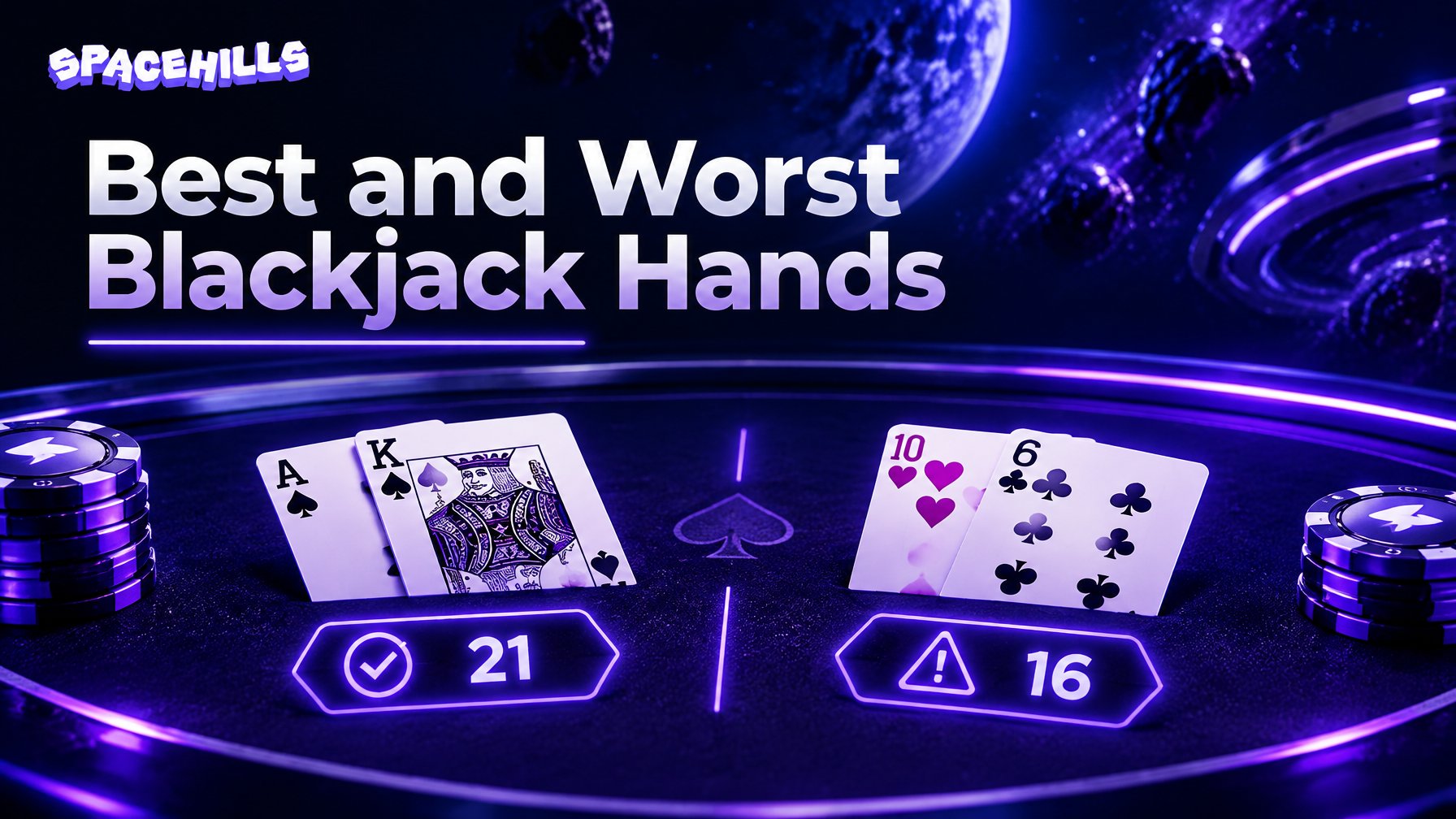
Best and Worst Blackjack Hands can sound like a mystery when you’re new to the table. Why do players cheer for a natural blackjack but groan at a hard 16? The answer comes down to your total, whether your hand is soft or hard, and the card showing in the dealer’s hand.
This guide explains each in plain language, ranks common hands by their value, and shows how the dealer and table rules can change your next move. For more blackjack guides, take a look around SpaceHills.
Meet the Best Hands in Blackjack
Great blackjack hands give you a strong total, a flexible way to improve, or a smart reason to stand. We’ll explore four beginner favorites: naturals, high totals, starting 10s or 11s, and pairs.
You’ll learn how the dealer’s upcard shapes your choices too because even a hand worth cheering for can still lose. Doubling or splitting requires an extra wager; see the promotions page for available promotions.
Blackjack, Explained for Beginners
A blackjack, or natural, is an Ace plus a 10-value card, 10, Jack, Queen, or King, dealt as your first two cards. Count the Ace as 11, and you’ve got 21! It beats most other 21s, but if the dealer also has a natural, it’s usually a tie, called a push.
Before you play, check the payout. A $10 natural pays $15 at 3:2 or $12 at 6:5, plus your original bet back. Same great cards, different table payout.
Totals That Are Hard to Beat
A hard total from 17 to 20 is often a good place to stand: drawing another card can bust you, and your total is already strong. A hard hand has no Ace counting as 11, so there’s no flexibility to cushion a high draw.
At the table, check the dealer’s upcard and follow a basic-strategy chart for your game. These totals often call for standing, but blackjack has exceptions. A strong total improves your position, it doesn’t promise the dealer will finish lower.
Why a Starting 10 or 11 Feels So Good
A starting total of 10 or 11 gives you a useful chance to improve with a 10-value card, which would make 20 or 21. That’s why basic-strategy charts commonly recommend doubling against certain dealer upcards, if the table allows it.
For example, hard 11 is often doubled, while hard 10 is commonly doubled when the dealer’s card is not too strong. The exact play depends on the upcard and house rules, so check the chart before acting. Doubling means adding another wager.
Pairs You Will Meet Early: Aces, Eights, Tens
A pair is two cards of the same rank, such as two 8s. Basic strategy commonly recommends splitting Aces and 8s: Aces can start two promising hands, while splitting 8s avoids keeping a hard 16. Split 10s are usually kept together as a strong 20.
Splitting requires an extra wager; see the welcome bonus offer for information about SpaceHills promotions. Offers do not change the odds or the strategy for your hand. Check the table rules and a strategy chart, since options can vary.
Meet the Worst Hands in Blackjack
The toughest blackjack hands aren’t always the lowest totals. They’re the ones that leave you choosing between two uncomfortable options: risk busting now or stand and hope the dealer struggles.
Let’s look at hard 16 and the stiff hands,hard 12 through 15, and see how the dealer’s upcard can guide your decision.

Why a Hard 16 Is So Unpopular
A hard 16 has no Ace counting as 11, so it can’t soften a high draw. Here’s the dilemma:
- Hit: A 6 or higher can push your total over 21 and bust.
- Stand: You keep 16, which may be lower than the dealer’s finished hand.
Basic strategy usually says to hit 16 against a dealer 7 through Ace, and stand against 2 through 6. If surrender is allowed, surrendering against some strong dealer cards, often 9, 10, or Ace, may be the recommended play, depending on the rules.
The Stiff Hands, in Plain Terms
A stiff hand is a hard total from 12 to 15. It’s called “stiff” because one big card can bust you, yet standing leaves you with a total the dealer may beat. No wonder beginners feel stuck!
Look at the dealer’s upcard before deciding. Against a weaker card, standing may be sensible because the dealer could bust. Against a stronger card, basic strategy may call for hitting. The right play varies by your exact total and the rules, so use a chart rather than treating every stiff hand the same.
Soft Hands for Beginners
A soft hand has an Ace currently counted as 11 without taking you over 21. That means one card can’t make you bust, the Ace can switch to 1. For example, soft 17 becomes hard 17 if you draw a 10.
That flexibility gives you room to improve, but it doesn’t mean you should always hit. Check a basic-strategy chart for your hand, the dealer’s upcard, and the table rules. To browse table games, visit SpaceHills’ casino game library.
Hard Hands for Beginners
A hard hand has no Ace counting as 11, or has an Ace that must count as 1 to keep you under 22. That makes it less forgiving: one high card can send you busting. Start by checking your total and the dealer’s upcard, then use a basic-strategy chart made for that table’s rules.
As a rough guide, low hard totals often need a hit, while hard 17 or more usually means stand. The best move depends on the exact hand.
Good Hand or Bad Hand? It Depends
A blackjack hand isn’t simply “good” or “bad.” Its value depends on the dealer’s upcard, the table rules, and whether you’re looking at your first two cards or your final total.
Take hard 16. It’s a difficult starting hand because hitting can bust, while standing may leave you behind. But it isn’t automatically the worst choice in every situation: the dealer’s card and the rules help determine what basic strategy recommends.
Even a strong final total can be lost if the dealer finishes higher. Think of your hand as one piece of the puzzle, not the whole picture!
How the Dealer’s Card Changes Everything
The dealer’s upcard gives you a clue about how much pressure you’re under. Cards 2 through 6 are generally considered weaker dealer cards because they leave the dealer more likely to bust while drawing to at least 17. Cards 7 through Ace are generally stronger.
For example, hard 16 feels a little less bleak against a dealer 6: standing lets the dealer take the risk of drawing. Against a dealer 10, that same 16 feels much shakier because the dealer has a strong starting card. Your hand hasn’t changed, but the matchup has. Use a strategy chart to choose the play for each situation.
House Rules That Change the Value of Your Hand
Your cards aren’t the only thing that matters, the table rules can change how favorable the game is. Start by checking these details before you play:
- Blackjack payout: A 3:2 payout is better for players than 6:5. On a $10 bet, that’s $15 versus $12 in winnings.
- Number of decks: Fewer decks generally favor the player, though the effect depends on the other rules.
- Dealer on soft 17: A dealer who hits soft 17 has an advantage over one who stands, all else being equal.
- Surrender: When available, it lets you give up a hand for half your bet; basic strategy recommends it in some situations.
These effects are reflected in blackjack rule analyses and basic-strategy charts from sources such as Wizard of Odds and the New York Times’ blackjack guide. Check the rules and use a chart matched to the game you’re playing.

Blackjack Myths Beginners Believe
Some blackjack advice sounds convincing, but basic-strategy charts tell a more useful story. Here are a few common myths to leave at the door:
- “Always split a pair of 10s.” Usually not. A pair of 10s makes 20, a strong total, so basic strategy generally says to stand.
- “A pair of 8s is already a decent 16.” Strategy charts commonly recommend splitting 8s instead, though exact advice can depend on the rules and dealer’s card.
- “A hard 16 should always be hit.” Not necessarily. The recommended move depends on the dealer’s upcard, and surrender may be an option in some games.
Published basic-strategy charts, including those from Wizard of Odds, make decisions based on the full situation, not a catchy rule. Use a chart for your table’s rules, and remember: strategy helps guide your choices, but it can’t guarantee a win.
What Each Hand Is Really Worth, Ranked
A hand’s Expected Value (EV) estimates the average result of a decision over many similar plays. For example, an EV of +0.50 units means an average gain of 50 cents per $1 wagered, not a promise of profit on the next hand.
There isn’t one honest EV for each hand without specifying the dealer’s upcard, rules, and choices available. Wizard of Odds’ expected-value tables show values by hand and dealer card, so the table below ranks these hands qualitatively, rather than inventing figures. “Starting” means the initial two cards; the dealer-card column shows why exact values vary.
| Hand | Dealer Upcard Assumed | Expected Value (per unit bet) | Source |
| Blackjack (natural) | Any; dealer has no blackjack | +1.50 with a 3:2 payout | Wizard of Odds |
| Starting 20 | Dealer 6 | About +0.5 to +0.9, depending on upcard | Wizard of Odds |
| Starting 11 | Dealer 6; best move depends on upcard | About +0.65 | Wizard of Odds |
| Pair of Aces | Dealer 6; splitting allowed | About +0.40 | Wizard of Odds |
| Soft 18 | Dealer 6; best move depends on upcard | About +0.20 | Wizard of Odds |
| Hard 16 | Especially dealer 10; compare low card too | About +0.20 | Wizard of Odds |
| Hard 12 to 15 | Compare dealer 2–6 with 7–Ace | Depends strongly on upcard | Wizard of Odds |
These figures should be read as long-run averages, not predictions for one round. The source’s detailed tables vary by deck count, dealer soft-17 rule, and whether the dealer checks for blackjack, so use the matching table for the rules you’re playing.
Blackjack Hand Questions From Beginners
-
A natural blackjack, an Ace and a 10-value card is the strongest starting hand. Together, they make 21 in just two cards and usually beat other 21s made with more cards. The dealer’s natural is the exception: it typically ties your hand, called a push.
-
Hard 16 is often considered one of blackjack’s toughest hands, but it isn’t always the worst. You risk busting if you hit, yet standing can leave you behind. Basic-strategy charts show the right move depends on the dealer’s upcard and rules. See Wizard of Odds’ strategy charts.
-
Yes, you can lose if the dealer also has a blackjack and the table treats it as a push. In that case, neither hand wins, and you usually get your original wager back. Otherwise, a natural generally beats a dealer hand that reaches 21 with more than two cards.
-
A hard hand has no Ace counting as 11. It either has no Ace, or its Ace must count as 1 to keep the total at 21 or less. Hard hands can bust more easily, so their strategy differs from soft hands, which have more flexibility.
-
Playing multiple hands doesn’t improve your odds of winning each hand. It simply means more bets are in play, so you could win or lose more in the same round. If you’re new, start with one hand, learn the decisions, and set a budget you’re comfortable with.