

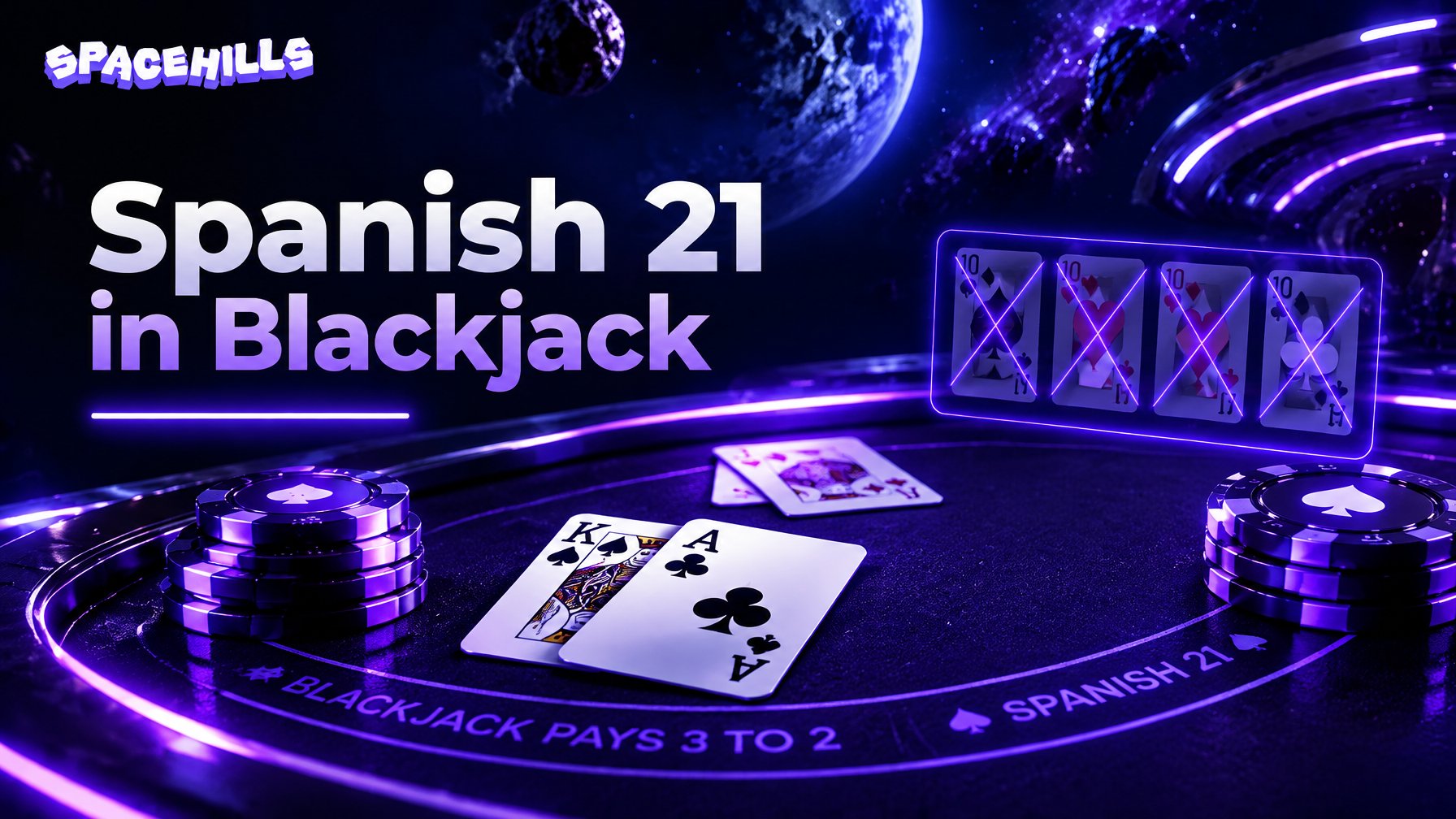
Spanish 21 is blackjack with a twist: the four 10s are missing from the deck, changing the odds and how you play. If you’re exploring the game on SpaceHills, this guide will help you get comfortable at the table before you place a bet.
We’ll walk through the rules that differ from regular blackjack, explain which bonus hands can pay extra, and compare the odds honestly. By the end, you’ll know what to look for, which rules to check, and how to make smarter decisions, without expecting any strategy to guarantee a win.
What Is Spanish 21?
Spanish 21 is a blackjack-style game where you take on the dealer, aiming for a hand closer to 21 without busting. The basic goal is easy to recognize if you know blackjack, but a few rule changes give Spanish 21 its own personality.
Getting familiar with casino games? You may come across casino promotions while exploring your options. Read the terms first, and check directly with the casino to see which games are available.
The Spanish Deck: What’s Missing and Why It Matters
Spanish 21 is played with 48 cards instead of the usual 52. The dealer removes all four 10s, one from each suit, but keeps the jacks, queens and kings, which still count as 10. Aces can count as either 1 or 11, whichever works better for your hand.
With fewer 10-value cards in the deck, hands like 20 show up less often than in standard blackjack. That’s the big twist to keep in mind. Bonus payouts and extra player options help make the game different, so check the table rules before you play.
The Object of Spanish 21
Your goal is to finish with a hand closer to 21 than the dealer’s, without going over. Beat the dealer and you win; bust first and you lose. If your total ties the dealer’s, the hand usually pushes, meaning your main bet is returned. Check the table rules, as ties can be handled differently.

How a Round of Spanish 21 Plays Out
A Spanish 21 hand follows a familiar rhythm: bet, receive cards, choose your moves, then settle up. At live dealer tables, watch the dealer’s instructions closely, since procedures can vary by casino.
- Place your main bet and, if you wish, a separate side bet.
- The dealer gives each player two cards and takes two cards, usually one face up and one face down.
- Choose to hit, stand, double, split or surrender if the table allows it.
- The dealer reveals the hidden card and completes their hand according to house rules.
- Bets are paid, lost or returned. Check how the table settles player 21s and bonuses, as these rules can differ from blackjack.
Hit, Stand and Insurance
Hit to take another card; stand to keep your current total and end your turn. If you’d like a deeper look at those basics, explore SpaceHills’ blackjack content, many of the same decisions apply, though Spanish 21 has its own rule twists.
Insurance may be offered when the dealer’s face-up card is an ace. It’s a separate wager that the dealer has a natural blackjack, and it’s settled independently of your hand. Not every Spanish 21 table offers insurance, so check the rules before betting on it.
Spanish 21 Rules That Differ From Blackjack
Spanish 21 looks a lot like blackjack, but several rules change how hands are played and paid. The differences below are worth learning before you sit down, because they can affect both your decisions and your final payout.

How Player Blackjack Works in Spanish 21
A two-card 21—an ace with a 10-value card—is usually called a natural or blackjack. In many Spanish 21 games, it pays even more money than the familiar 3:2 blackjack payout, and it may be settled separately from a dealer.
That can matter because all four 10s are missing, making a natural less common. The exact payout and whether the dealer’s nature affects your hand depends on the table’s rules. Check the posted rule sheet before betting; payouts are not identical at every casino.
Player 21 vs Dealer 21 in Spanish 21
In many Spanish 21 versions, a player’s 21 beats a dealer’s 21, so the player wins instead of pushing. Some tables also pay a bonus when the player reaches 21 with several cards, but qualifying card counts and payouts vary.
Don’t assume every 21 gets the same treatment. A two-card natural, a multi-card 21 and a 21 made after splitting may be handled differently under the house rules. Before playing, check the table’s payout schedule and ask the dealer if it’s unclear.
Pair Splitting in Spanish 21
When your first two cards have the same rank, many Spanish 21 tables let you split them into two hands by placing an extra bet equal to your original wager. You then play each hand separately. How often you can re-split depends on the casino.
Aces may have special restrictions: some tables let you split them only once, while others allow re-splitting. After splitting, you may be able to hit or double, but rules for split aces can be tighter. Check the posted limits before you act.
Doubling Down in Spanish 21
To double down, you add a bet, usually matching your original wager and receive one more card. A common Spanish 21 rule allows doubling on any initial two-card total, and many tables permit doubling after a split. Restrictions vary, so confirm them at your table.
Unlike some blackjack games, the option may not be limited to totals such as 9, 10 or 11. For a closer look at when to double down in blackjack, explore a dedicated blackjack guide, but use Spanish 21 strategy for Spanish 21 decisions.
Double Down Rescue in Spanish 21
Double Down Rescue lets you surrender a doubled hand after receiving its one additional card, where the casino offers this option. You give up the hand but may recover your original wager; the extra amount used to double is lost.
For example, imagine you bet $10, double to $20, then choose rescue. Under a common version, you get your original $10 back and forfeit the $10 double. It’s not available everywhere, and the exact timing and refund rules depend on the table.
Surrender in Spanish 21
Surrender lets you give up your hand and recover part of your original bet. At tables offering late surrender, you usually make this choice after the dealer checks for blackjack, but before taking another card. A common arrangement returns half the wager.
If the dealer has blackjack, surrender may not be available—or the hand may be settled as a loss, depending on the rules. Casinos can differ on timing, eligible hands and how surrender interacts with doubling or splitting. Read the table rules before using it.
Spanish 21 Bonus Payouts
Spanish 21 bonus payouts reward certain hands that total 21, with some combinations paying more than even money. These prize-style bonuses may remind you of slot games, but they follow specific card rules, so check the table’s pay chart before you play.
There isn’t one universal payout chart: amounts and qualifying details vary by casino. The table below shows a commonly published example; treat it as a guide, not a promise.
|
Bonus Hand |
Pays |
Notes |
| 5-card 21 | 3:2 | Example payout; rules may specify eligible cards |
| 6-card 21 | 2:1 | Check whether all six cards must count |
| 7+ card 21 | 3:1 | Qualification varies |
| 6-7-8 mixed suits | 3:2 | Three-card 21 |
| 6-7-8 suited | 2:1 | Same suit |
| 6-7-8 spades | 3:1 | All three cards are spades |
| 7-7-7 mixed suits | 3:2 | Three sevens |
| 7-7-7 suited | 2:1 | Same suit |
| 7-7-7 spades | 3:1 | All three cards are spades |
The Super Bonus Hand
The Super Bonus is an extra payout offered at some Spanish 21 tables when a player makes three 7s and the dealer’s face-up card is also a 7. The bonus amount may depend on the player’s main bet, and some tables set additional conditions, such as the suits of the 7s.
Check the table’s pay schedule to confirm the exact trigger and payout. The Super Bonus is an in-game payout, not a casino promotion, and it may not be offered at every venue.
The Spanish 21 Envy Bonus
An Envy Bonus rewards other players at the table when someone lands a qualifying hand, often a high-paying bonus combination. You don’t have to make that hand yourself to receive the extra payout, but eligibility rules vary.
It’s a table payout rule, not a promotion. The casino sets the amount and qualifying hands, so check the pay table before joining in.
Match the Dealer: The Spanish 21 Side Bet
Match the Dealer is an optional wager you place alongside your main bet, usually before the cards are dealt. It wins when either of your first two cards matches the dealer’s face-up card by rank; a match in suit can qualify for a different payout.
The side bet is settled separately, so it won’t change how you play your main hand. Minimums, maximums and payout schedules vary by casino. At Rivers Casino Philadelphia, for example, the published limit is $1 minimum, up to your main bet, with a $500 maximum. Check the table’s current rules before betting.
How Match the Dealer Bets Are Paid
Rivers Casino Philadelphia’s published Spanish 21 page lists the following Match the Dealer payouts. The schedule applies to that casino’s game; other casinos may use different payouts, so check their posted pay table before placing a side bet.
|
Match Type |
Pays |
Casino Source |
| 1 non-suited match | 3:1 | Rivers Casino |
| 2 non-suited matches | 6:1 | Rivers Casino |
| 1 suited match | 2:1 | Rivers Casino |
| 1 non-suited and 1 suited match | 15:1 | Rivers Casino |
| 2 suited matches | 24:1 | Rivers Casino |
Basic Strategy and Tips for Spanish 21
Spanish 21 needs its own basic strategy: the missing 10s change the odds, and rules like bonuses, surrender and doubling affect the best move. A standard blackjack chart may lead you astray, so use a Spanish 21 strategy chart that matches your table’s rules. Check the chart’s source and rule assumptions before relying on it.
A few smart habits can make play easier:
- Read the felt and pay table first. Note the dealer’s soft-17 rule, doubling options and surrender rules.
- Keep your decisions steady. Use the same rule-matched strategy instead of changing course after a win or loss.
- Set a budget and session limit. Bonuses and side bets can be exciting, but they don’t guarantee a profit.
Strategy helps you make informed choices; it can’t remove the house edge.
Spanish 21 Table Rules and Etiquette
At a live table, place your bet in the marked area before the deal and wait for the dealer to confirm it. If you’re dealt face-up cards, signal your choice clearly, commonly by tapping the table to hit or waving a hand to stand. Follow the dealer’s instructions rather than reaching for cards or chips.
Procedures differ by venue, especially for handling cards and hand signals. If you’re unsure, ask the dealer before the next hand.
Spanish 21 vs Blackjack: How the House Edge Compares
There’s no single house-edge figure for Spanish 21—or blackjack. The estimate changes with the table rules and whether you follow the correct basic strategy. Spanish 21’s bonuses and player options can offset some of the effect of removing the 10s, but they don’t make every version equally favorable.
Use figures only when the source names its assumptions. The examples below show why comparing games requires a specific rule set; they aren’t universal casino odds.
|
Game |
Rule Set Assumed |
House Edge |
Source |
| Spanish 21 | Six decks; common player-friendly rules; optimal strategy | About 0.4% | Wizard of Odds |
| Spanish 21 (alternate rule set) | Different payouts and player options; exact rules affect result | Varies (confirm against the specific rules) | Wizard of Odds |
| Standard blackjack | Six decks; dealer stands on soft 17; 3:2 natural; optimal strategy | About 0.4% | Wizard of Odds |
Treat these as rule-dependent estimates, not a promise of what you’ll experience. Before choosing a table, check its pay schedule and compare it with a strategy chart built for those exact rules.
Spanish 21 Rules That Vary by Casino
Spanish 21 may look familiar from one casino to the next, but side bets, payouts and special rules can differ. Here’s what the three casinos’ published pages specify. “Not stated” means the page doesn’t provide that detail, it doesn’t mean the option is unavailable. Check the table’s current rules before placing a bet.
|
Rule |
Seneca Buffalo Creek Casino |
Blue Lake Casino |
Rivers Casino Philadelphia |
| Match the Dealer payouts | Not stated | Not stated | Non-suited match: 3:1; two non-suited: 6:1; suited match: 2:1; one suited + one non-suited: 15:1; two suited: 24:1 |
| Match the Dealer bet limits | Not stated | Not stated | $1 minimum; up to the main bet, maximum $500 |
| Double Down Rescue offered | Yes; recover the doubled portion and forfeit the original wager | Not stated | Yes; recover the doubled portion and forfeit the original wager |
| Insurance offered | Not stated | Described as an option when dealer shows an ace | Yes; up to half the original wager when dealer shows an ace |
| Surrender terms | Not stated | Late surrender described; half the bet is forfeited | Half the wager may be surrendered on the first two cards; dealer blackjack means the full wager is lost |
| Bonus payout differences | Not stated | 5-card 21: 3:2; 6-card: 2:1; 7+ cards: 3:1; 6-7-8 and 7-7-7 bonuses listed | 5-card 21: 3:2; 6-card: 2:1; 7+ cards: 3:1; 6-7-8 and 7-7-7 bonuses, plus Super Bonus and Envy Bonus |
Published summaries may not cover every table variation, so confirm the posted pay table and rules with the casino before playing.
Frequently Asked Questions
-
No. If you know blackjack, you’ll recognize the goal and many of the basic moves. The extra rules, such as bonuses, surrender and Double Down Rescue, take a little practice. Start by reading the table rules and using a Spanish 21 strategy chart.
-
Yes. Spanish 21 can pay bonuses for certain hands, while blackjack payouts and how ties are settled may differ. Exact payouts depend on the casino’s rules, so check the table’s pay schedule before you play.
-
Card counting is possible in principle, but Spanish 21’s rules and bonus payouts make it more complex than simply applying a blackjack system. Casinos also set their own procedures. Counting doesn’t guarantee a profit, and casino policies may restrict it.
-
A Spanish 21 deck has 48 cards: the four 10s are removed, while jacks, queens and kings remain and count as 10. Many games use multiple 48-card decks, so check the rules for the table you’re playing.
-
It depends on the casino’s rules. Tables often allow re-splitting pairs up to a set limit, but aces may have stricter rules. Check the posted rules for the maximum number of hands and what actions are allowed after splitting.